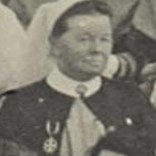

Matron Elizabeth Ann Dowse
RAMC member | General Duties Medical Officers-320.10.1855
Biography
D.O.B: October 20, 1855 {61}
P.O.B: Bristol, England {English}
Cabin: Matron
Occupation: Queen Alexandra’s Imperial Nursing Service Matron
QAIMNS Position: Matron {July 24, 1908}
"...a sixty year old 'dug-out' with a red cape and a row of South African medals."
⋆ Capable, zealous, and of strong character, Elizabeth Ann Dowse’s upbringing before being trained as a nurse were far from just mystery. All that’s to know of her is that she grew up in Bristol, born on October 20, 1855. Alongside her, she was the second oldest out of her four siblings Thomas, Aaron, Charles, and Florence. Somewhat aged at the time of the infamous ship she served greatly on, Matron Dowse was remarked in quite unique ways. Continuously caring towards her patients and sisters, she seemed tough, but remained rigid towards what she was called to do.
⋆ Dowse’s perpetual nursing duties began in April 1878 when she’d receive her training at 22 years old at the St. Mary’s Hospital in Paddington. However, she is denoted as a ‘sister before training.’ In the midst of equipping herself with the right knowledge and abiding by the matron ordering her, Dowse would be appointed on April 3, 1881 as an employed nurse at the same hospital. However, it didn’t take her long to start serving overseas. In the span of 4 years, Dowse would be sent out to serve in the Egypt Nile Expedition with the National Aid Society, a rather arduous task for those a part of this military mission. At the same time, she’d also tend to serve in the Suakin Expedition at the Red Sea, all before being appointed a Nursing Sister to the Army Nursing Service (ANS).
⋆ At the conclusion of wedging in 2 military missions as a seeming novice, Dowse served further in a military hospital in Gibraltar from October 1886-October 1891, holding the same rank. She faced later transfers back to her motherland for Netley Services at the Royal Victoria hospital in October 1891-April 1893, transferring over 2 years later to the Royal Herbert Hospital for Woolwich Services on April 13, 1895. In 1897, Dowse was deemed fit for promotion to Superintendent and was appointed as such on July 1, 1898.
⋆ 1899 would bring the Second Boer War, where Dowse would earn her South Africa Service Medal, a campaign one, and would serve in operations in Natal as well as Orange River Colony. Dowse would also serve onboard hospital ship ‘Nubia,’ still holding her superintendent rank. In the midst of her dutiful work and the war, she was granted the Royal Red Cross (R.R.C postnominals) on September 27, 1901 by Lord Kitchener. At the conclusion of the Second Boer War, Dowse would be granted yet another medal, the King’s South Africa Medal, on May 8, 1903.
⋆ Just after obtaining her well-earned South Africa Medal, Dowse would be posted to Cork as a Superintendent acting Matron. This would also be after being cited as ‘fit for a higher grade.’ Her efforts at Cork would be referred to as ‘in accordance with QAIMNS most satisfactorily’ in September of 1904. This meant that just 4 years later, she’d officially hold her notorious rank as Matron on July 24, 1908. Holding such a hierarchical rank, she’d embark for Malta a few months later on March 4, 1909, then would later be transferred in October 20, 1909 to Alexandria, Egypt.
⋆ Nearing past her middle age of life, Matron Dowse would retire from the QAIMNS on October 20, 1910. Already pushing past the QAIMNS age requirement and age of leave, this would occur on the day of her birthday at 55 years old. While subject to Her Majesty Queen Alexandra’s sanction, she’d remain allowed to retain her Badge of Queen Alexandra’s Imperial Nursing Service on retirement.
However, she’d later rejoin the service, reasons unknown, on November 2, 1914. For just the service itself, she’d rack up a total service of 24 years with 2 years as matron.
⋆ Dowse’s duties commenced once more, now in the Great War, at the Norwich Hospital at Lakenham School. As 2 years of the raging war passed on, Dowse would be requested to be present as Matron aboard His Majesty’s Hospital Ship Britannic which was deemed to set sail in 14 days on September 1st, at the time of her potential transfer. Immediately, a medical certificate would be forwarded to the War Office to deem her prominent competence for a role not much unfamiliar to her. With this, she wrote, “I have the honour to report my departure, this day, for Southampton, to cover the duties of Matron on the Hospital Ship ‘Britannic’ in accordance with orders received by the War Office telegram on September 1, 1916.”
"How seldom it is that this type of courage goes with an imaginative heart, a sensitive, intelligent mind!"