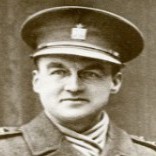

The Reverend Father Albert B Knight
Medical worker | Medical Officers-1214.3.1881
Biography
"Those advocates of war have never been caked in the cold trench mud, nor worn a coat weighted with mud and blood, nor heard the cries of the wounded and dying. Have you seen your brother weeping in a cot, your son frozen in the dirt, heard in your midst the cruel sounds of death? What is it all for?"
Diary of Albert B. Knight, Chaplain 4th Class (equiv. Captain), 1916
Born in the village of Kilternan, near Dublin, as the third of four children, Albert Knight did not have the same burden of expectations as his two older brothers. This enabled him to spend more of his time reading books lent to him by his neighbors and wondering about the nature of life rather than the way to pack the most boxes of fruit into the cart into town. Albert spent much of his early childhood walking between his home, the schoolhouse, the market, and the church, though he never could decide what he wanted to do with his life. He grew up with knowledge of both Irish Gaelic and English.
Eventually, after years as an altar server and a deep conversation with a priest in the confessional, Knight decided to pursue the priesthood. He went to the seminary at St. Patrick's in Maynooth, among Ireland's most prestigious Catholic institutions, and was ordained by Archbishop William Walsh of Dublin in 1906. With promising grades from Maynooth he was invited to pursue further education on the continent, receiving his Master's degree in 1911 from the Pontifical Gregorian University in Rome, but under the intense academmic pressure dropped out before completing his doctoral studies. Some will say he was punished for this decision by being assigned to a rather poor parish in St Giles in London rather than a proper teaching job, though he was apparently content in this position. He made occasional visits to Dublin to visit family, making the long journey by train and boat every few months when times were less busy.
When war broke out on the continent in 1914, Cardinal Francis Bourne requested Catholic chaplains for the war effort. Knight was recommended within the Archdiocese of Westminster, and while he was hesitant about serving the Crown, was ultimately motivated to accept by the need for the Sacraments in the field of war particularly for his fellow Irish Catholics being sent to the battlefields.
With the Royal Irish Fusiliers, Knight saw early action at Le Cateau in August 1914, where he came under shellfire while at an aid post. Other stories of courage and valor involve him carrying wounded behind the frontlines at Ypres and adminstering the Extreme Unction under artillery fire at Festubert, though he insists such stories are the exception. More to his liking is the story of a football game during an impromptu truce on New Year's Day 1915, when he scored the winning goal in a game against a German side somewhere in Belgium.
The regiment moved to Salonika in late 1915, sending him to the Gallipoli campaign and giving him some familiarity with the landscapes of Greece. Despite the consistent praise for his bravery and even suggestions of an early promotion, he continued to lament the conflict in private, and silently encouraged his fellow Irish to keep the tricolor in their trenches against superiors' wishes. He finally saw some relief from action at the fronts in August 1916, when he was reassigned to the HMHS Britannic as one of the ship's chaplains. This is Father Knight's, or the Padre's, 3rd voyage with the vessel.